Here is the entire photo album -- 278 photos, for the adventurous. We've also got a 40-minute long video summary of the trip to upload later.
Sunday, December 9, 2007


Sunday, November 18, 2007
home again
Our last day in Peru was very long, often stressful, but also included some good experiences. We couldn't get a boat trip arranged -- Saturday was already booked -- so we decided to rent a car and play Che Guevara, riding up the Pan American Norte toward Barranca. We stored our bags at the airport, rented a car, and headed north.
Let me just say that driving in Lima certainly isn't as frightening as driving in Vietnam or India would've been; at least the alphabet is familiar, and I could usually make a pretty strong guess about what the signs said. It's just that the traffic patterns are nuts, people honk all the time, pedestrians cross at random times and places, and I was afraid I'd kill someone. It's fun to drive, it's extra fun to drive a stick shift, but driving in crazy crowded Lima traffic was very very stressful.
We finally left Lima behind and drove through kilometers of the most barren wasteland we've ever seen. High drifts and low mountains of sand, tan colored as far as we could see. The occasional small and unexpected town full of little shacks, in the middle of nothing, with not a single blade of green anything, anywhere. We stopped at a strange and beautiful nature reserve for a nice walk.
 pipe organ cactus
 these were everywhere
 It was strange: green hillsides, lots of flowers,
and dead-looking trees


 the view toward the ocean

We never made it to Barranca; we stopped in a town called Huaracha for some lunch, and had what was probably our most authentic Peruvian experience. Although no one paid us any attention whatsoever, I doubt there are many tourists in Huaracha. It's a fishing village, and we found our way to the waterfront where there were several cevicherias. We picked the most open and friendly-looking one, and ordered some food. I thought I was ordering shrimp cebiche, and Marc ordered some kind of fish that was fried, that's about all we knew. His was really wonderful, he said, but mine was a plate full of crawdads, heads and long wiry antennae and all. If my stomach weren't so full of stress and acid from driving out of Lima, I might have been able to manage it a bit more, but seeing that plate piled high with mud bugs just pushed me over the edge and I was trying not to cry. Marc switched plates with me and said it was really good, too. We made a little video of the waterfront on our way out of town, if it's decent, I'll post it so I can remember.
We got back to Lima around 8:30, I think, very frightening driving in the dark with all the rest of the Lima stuff, plus intense smog. Pollution, fog, I don't know, but it was thick. Our plane left at 11:59 or thereabouts, so we had a long time to sit around the airport. At least it's a much nicer airport than the Delhi airport.
And now we're home. It's really great to be home. The trip was truly a dream, we're so happy that we went, so happy that we were together for this trip, and we have a lot of work to do finishing up the photos. I have one more post to make, but it may take a few days. For now, ciao ciao.
Let me just say that driving in Lima certainly isn't as frightening as driving in Vietnam or India would've been; at least the alphabet is familiar, and I could usually make a pretty strong guess about what the signs said. It's just that the traffic patterns are nuts, people honk all the time, pedestrians cross at random times and places, and I was afraid I'd kill someone. It's fun to drive, it's extra fun to drive a stick shift, but driving in crazy crowded Lima traffic was very very stressful.
We finally left Lima behind and drove through kilometers of the most barren wasteland we've ever seen. High drifts and low mountains of sand, tan colored as far as we could see. The occasional small and unexpected town full of little shacks, in the middle of nothing, with not a single blade of green anything, anywhere. We stopped at a strange and beautiful nature reserve for a nice walk.
have you ever seen green flowers?
 pipe organ cactus
 these were everywhere
 It was strange: green hillsides, lots of flowers,
and dead-looking trees


 the view toward the ocean
We never made it to Barranca; we stopped in a town called Huaracha for some lunch, and had what was probably our most authentic Peruvian experience. Although no one paid us any attention whatsoever, I doubt there are many tourists in Huaracha. It's a fishing village, and we found our way to the waterfront where there were several cevicherias. We picked the most open and friendly-looking one, and ordered some food. I thought I was ordering shrimp cebiche, and Marc ordered some kind of fish that was fried, that's about all we knew. His was really wonderful, he said, but mine was a plate full of crawdads, heads and long wiry antennae and all. If my stomach weren't so full of stress and acid from driving out of Lima, I might have been able to manage it a bit more, but seeing that plate piled high with mud bugs just pushed me over the edge and I was trying not to cry. Marc switched plates with me and said it was really good, too. We made a little video of the waterfront on our way out of town, if it's decent, I'll post it so I can remember.
We got back to Lima around 8:30, I think, very frightening driving in the dark with all the rest of the Lima stuff, plus intense smog. Pollution, fog, I don't know, but it was thick. Our plane left at 11:59 or thereabouts, so we had a long time to sit around the airport. At least it's a much nicer airport than the Delhi airport.
And now we're home. It's really great to be home. The trip was truly a dream, we're so happy that we went, so happy that we were together for this trip, and we have a lot of work to do finishing up the photos. I have one more post to make, but it may take a few days. For now, ciao ciao.
Friday, November 16, 2007
leaving the Sacred Valley
It seemed to take days and days, but it was finally time to leave Aguas Calientes. You know how long the hours are, when there is not much to do. So we wandered back to our hotel through occasional little spits and spots of rain, almost unnoticeable, to pick up our backpacks.
And then, le deluge. The skies opened up and poured buckets and buckets of rain on us. We had our Goretex raincoats, which we wrapped around our shoulders and our backpacks full of gear (cameras, etc) and made a run for the train station on the other side of the river. By the time we got there, our pant legs were soaked, as were our feet, but the gear was dry. We settled in for the 4-hour train ride home.
So this is the funny thing about public transit in Peru: the entertainment. On the bus home from Nasca, cards were distributed for Bingo. The whole bus (except us, I think), played Bingo. It was funny. PeruRail does something wilder. On the ride back to Cusco, the attendants put on a fashion show. I had my eyes closed, but I heard the music.....runway style music. Marc said the attendants were doing the whole shtick -- the model facial expressions, the runway strut, the turns. When it was all over, they wheeled a trolley up and down the aisles selling traditional alpaca stuff, sweaters, hats, socks, etc. Before the fashion show, a guy came out in some kind of old traditional clothing with a white face mask covering his head, with red slits for the eye holes. It totally freaked me out, I did not like it at all.
Pulling into Cusco felt like coming home. I swear I think I could easily chuck it all and open a little shop in Cusco for the rest of my days. Marc and I went back to the restaurant run by those two girls and ordered three dishes, which were (as before) cooked individually, after running out for ingredients. Yum.
Yesterday we flew back to Lima, back to the hotel (and room) we left so long ago. It's an odd feeling; our vacation is really over, but it's not over yet. We have to kill time in Lima until our flight leaves just before midnight tomorrow night. We're trying to figure out how to spend all day Saturday after we check out of our hotel. Maybe a cruise around some nearby islands (called, like all the nearby islands, the little Galapagos), maybe rent a car and drive north, who knows.
I feel (and so does Marc, I think) ready to get home. This has been so remarkable, a truly unique and amazing trip. It's the first place we've been together that we both would come back to. I'm not at all eager to go back to work, but I think it's time to get home. Since I don't have a computer, and next week is Thanksgiving, it may take a couple of weeks before I get photos uploaded, but if you are interested, I'll post a note on my main blog when the photos are here.
As everyone here says, ciao ciao.
And then, le deluge. The skies opened up and poured buckets and buckets of rain on us. We had our Goretex raincoats, which we wrapped around our shoulders and our backpacks full of gear (cameras, etc) and made a run for the train station on the other side of the river. By the time we got there, our pant legs were soaked, as were our feet, but the gear was dry. We settled in for the 4-hour train ride home.
So this is the funny thing about public transit in Peru: the entertainment. On the bus home from Nasca, cards were distributed for Bingo. The whole bus (except us, I think), played Bingo. It was funny. PeruRail does something wilder. On the ride back to Cusco, the attendants put on a fashion show. I had my eyes closed, but I heard the music.....runway style music. Marc said the attendants were doing the whole shtick -- the model facial expressions, the runway strut, the turns. When it was all over, they wheeled a trolley up and down the aisles selling traditional alpaca stuff, sweaters, hats, socks, etc. Before the fashion show, a guy came out in some kind of old traditional clothing with a white face mask covering his head, with red slits for the eye holes. It totally freaked me out, I did not like it at all.
Pulling into Cusco felt like coming home. I swear I think I could easily chuck it all and open a little shop in Cusco for the rest of my days. Marc and I went back to the restaurant run by those two girls and ordered three dishes, which were (as before) cooked individually, after running out for ingredients. Yum.
Yesterday we flew back to Lima, back to the hotel (and room) we left so long ago. It's an odd feeling; our vacation is really over, but it's not over yet. We have to kill time in Lima until our flight leaves just before midnight tomorrow night. We're trying to figure out how to spend all day Saturday after we check out of our hotel. Maybe a cruise around some nearby islands (called, like all the nearby islands, the little Galapagos), maybe rent a car and drive north, who knows.
I feel (and so does Marc, I think) ready to get home. This has been so remarkable, a truly unique and amazing trip. It's the first place we've been together that we both would come back to. I'm not at all eager to go back to work, but I think it's time to get home. Since I don't have a computer, and next week is Thanksgiving, it may take a couple of weeks before I get photos uploaded, but if you are interested, I'll post a note on my main blog when the photos are here.
As everyone here says, ciao ciao.
Wednesday, November 14, 2007
Machu Picchu
It was so sunny and beautiful yesterday when we arrived in Aguas Calientes. We went straight to our hotel and couldn't check in for an hour or so, so we sat at a little cafe and got the ever-present limonade (made of whole limons, whirred in a blender with water and sugar, skins and all. It's incredibly refreshing and delicious). We decided to head up to the mountain around 2pm, when it is supposed to clear out, as organized tours leave to catch the 3:30 train to their next stop.
It was very confusing. We had to buy bus tickets in one place, and a ticket onto the site at another place. We got conflicting information about when the bus left for Machu Picchu, and when the last bus left to come back to town. The ticket to Machu Picchu was almost twice the amount we thought, which meant $80. OK, you only do this once. You don't come here, you don't come this far, to let the ticket price stop you. It was just surprising.
Our weary nerves and all the confusion frayed us and we had to reorient ourselves to each other again. We'd had very little sleep the night before, and had gotten up at 4:45am, so I think we were just a little bit cranky.
We barely caught a bus; Marc whistled and shouted just as one was pulling away, and we got on. There were just two seats, and not together, but who cares for the 25-minute trip up the mountain. Then the man sitting next to me smiled and got up to sit in the other empty seat so Marc and I could sit together. This is characteristic of the people we've encountered -- they're friendly and engaging.
The ride up the mountain was by turns breathtaking and a little scary, as the road seemed wide enough for one bus quite easily, but not so much for two buses. And of course there were nonstop buses coming back down the mountain, so we were often squeezing past each other. This wasn't so scary when we were on the inside lane, but when we were outside and seemingly hanging on the edge of the road, on the edge of a mountain, it was a little pulse-increasing. When we got near enough to start seeing the site, and the other site much higher on a facing mountain, it felt like my mind just stopped in awe. We were at Machu Picchu.


When we walked into the site, we stopped on a terrace and sat in the shade of the terrace above, to just look. I think we both could've just done that for hours. The clouds on the facing mountain tops were constantly shifting, as was the light. The whole site was much greener than we expected. And the site itself was much more amazing than we expected. You know how you think about these iconic places for decades, building them up a little, and then they're not quite as awesome as all that? Machu Picchu is not like that at all. It exceeded my imagination, by far.


 The stonework was really amazing -- sometimes square, sometimes here and there, sometimes straight courses, other times just cut to fit:


The Temple of the Condor was really interesting -- on the floor of that space was a sculpted representation of the condor's head, and the wall behind the head had two enormous rock faces going upward as wings.
 wings
wings
As amazing as the buildings and rooms and temples and terraces are -- and they really are -- for me, anyway, it was the vista that made it so breathtaking. Marc and I picked our way through the site, stopping everywhere just to look at the views.


There's this amazing massive rock that was carved to echo the mountaintops it faced. It is a near-perfect imitation. Those Incas were truly brilliant; one thing I meant to post earlier, from our Colca Valley trip, was that when they built a site, they first carved a stone model -- an exact model -- of their building site, so they could see how the water would flow downward, etc. Really brilliant.
 It was sunny and a little cool, with a breeze that just kept the temperature perfect. The air was sweet and clear, the skies were blue but the mountaintops were shrouded in clouds, and it simply could not have been better, in any way. We soaked ourselves in it and stayed until the last buses were leaving. As we sat on a terrace, taking our final looks at the view, an enormous flock of green parrots took off from our right, wheeling and squawking as they flew past us. They were brilliant in the sun, and it seemed like some kind of dream.
 And one final thing that happened, that you wouldn't believe unless you know and trust me: while we sat watching the mountains and clouds, a heart-shaped hole opened up in the clouds directly in front of us. It wasn't almost heart-shaped, or kind of heart-shaped. It was an exact, perfect heart:
 I just don't have the words to describe this experience. Awesome, magnificent, amazing, incredible, breathtaking, puny little pale words.
It was very confusing. We had to buy bus tickets in one place, and a ticket onto the site at another place. We got conflicting information about when the bus left for Machu Picchu, and when the last bus left to come back to town. The ticket to Machu Picchu was almost twice the amount we thought, which meant $80. OK, you only do this once. You don't come here, you don't come this far, to let the ticket price stop you. It was just surprising.
Our weary nerves and all the confusion frayed us and we had to reorient ourselves to each other again. We'd had very little sleep the night before, and had gotten up at 4:45am, so I think we were just a little bit cranky.
We barely caught a bus; Marc whistled and shouted just as one was pulling away, and we got on. There were just two seats, and not together, but who cares for the 25-minute trip up the mountain. Then the man sitting next to me smiled and got up to sit in the other empty seat so Marc and I could sit together. This is characteristic of the people we've encountered -- they're friendly and engaging.
The ride up the mountain was by turns breathtaking and a little scary, as the road seemed wide enough for one bus quite easily, but not so much for two buses. And of course there were nonstop buses coming back down the mountain, so we were often squeezing past each other. This wasn't so scary when we were on the inside lane, but when we were outside and seemingly hanging on the edge of the road, on the edge of a mountain, it was a little pulse-increasing. When we got near enough to start seeing the site, and the other site much higher on a facing mountain, it felt like my mind just stopped in awe. We were at Machu Picchu.
First, the video:


When we walked into the site, we stopped on a terrace and sat in the shade of the terrace above, to just look. I think we both could've just done that for hours. The clouds on the facing mountain tops were constantly shifting, as was the light. The whole site was much greener than we expected. And the site itself was much more amazing than we expected. You know how you think about these iconic places for decades, building them up a little, and then they're not quite as awesome as all that? Machu Picchu is not like that at all. It exceeded my imagination, by far.


 The stonework was really amazing -- sometimes square, sometimes here and there, sometimes straight courses, other times just cut to fit:


The Temple of the Condor was really interesting -- on the floor of that space was a sculpted representation of the condor's head, and the wall behind the head had two enormous rock faces going upward as wings.
head
 wings
wings
As amazing as the buildings and rooms and temples and terraces are -- and they really are -- for me, anyway, it was the vista that made it so breathtaking. Marc and I picked our way through the site, stopping everywhere just to look at the views.


There's this amazing massive rock that was carved to echo the mountaintops it faced. It is a near-perfect imitation. Those Incas were truly brilliant; one thing I meant to post earlier, from our Colca Valley trip, was that when they built a site, they first carved a stone model -- an exact model -- of their building site, so they could see how the water would flow downward, etc. Really brilliant.
 It was sunny and a little cool, with a breeze that just kept the temperature perfect. The air was sweet and clear, the skies were blue but the mountaintops were shrouded in clouds, and it simply could not have been better, in any way. We soaked ourselves in it and stayed until the last buses were leaving. As we sat on a terrace, taking our final looks at the view, an enormous flock of green parrots took off from our right, wheeling and squawking as they flew past us. They were brilliant in the sun, and it seemed like some kind of dream.
 And one final thing that happened, that you wouldn't believe unless you know and trust me: while we sat watching the mountains and clouds, a heart-shaped hole opened up in the clouds directly in front of us. It wasn't almost heart-shaped, or kind of heart-shaped. It was an exact, perfect heart:
 I just don't have the words to describe this experience. Awesome, magnificent, amazing, incredible, breathtaking, puny little pale words.
blogging in the Andes
OK, this is surreal. I'm sitting in an internet cafe in Aguas Calientes, Peru, looking out the enormous window at the Andes and a huge statue of an Incan, listening to house music.
 The particular mountain I'm facing has these beautiful yellow-green plants hanging on the mountain's face, with dusky red leaves or maybe flowers, I can't tell from here. The sky is blue, and the tops of the mountains disappear into clouds. It boggles my weary little mind.
Yesterday morning we boarded the 6am train from Cusco to Aguas Calientes, which is the little village you spend the night in if you are seeing Machu Picchu. Leaving Cusco:
 We took the Vista Dome train, which meant we not only saw the landscape through the windows at our sides, we could look up and see the mountains above our heads. It was magnificent. We thought the Vista Dome would be cool, but I don't think we could really appreciate what it would be like.


Train ride: The movie!
As with everything else on this trip, it was better than we hoped. We wound our way through the higher ground of the Cusco area, then dropped down into the valley that leads to Machu Picchu.
Peru Rail did this really cool thing, very smart as far as we can tell. You know how you go up a mountain by zig zagging, hairpin turns, so the incline isn't so steep? Well, the switchbacks in the Andes end in straight track, then the train backs up and goes to the next path. I can visualize it if I blur my mental eyes a little. We weren't even out of Cusco when we hit the first one, so when the train started going in reverse, Marc and I were a little nervous. But no one else seemed to notice, and then we figured it out.
 So Cusco is kind of dusty, but when we dropped down into the valley, the landscape changed so dramatically. It kind of looked like Louisiana, lush and with what I think are cypress trees. The homes were no longer adobe, but really did look like houses you'd see in the rural areas of Louisiana. There were tropical plants and it just couldn't have looked more different.
There were these large areas of paradise, it seemed to me. Acres and acres (well, here it would be hectares and hectares) of farmed land, crops planted in neat rows. Cattle and sheep grazing. Little creeks and rivers flowing past beautiful adobe homes. And of course gorgeous mountains all around. Gorgeous Andean mountains, some with snow on the tops, some with clouds hovering around the tops, some just jagged rock. It was truly breathtaking.
 fertile, beautiful farmland
 snow- and glacier-topped mountains
 random Incan ruins scattered everywhere
 more snowy cloudy mountains
 Aguas Calientes exists solely for the purpose of housing and feeding tourists, and selling them crappy tchotchkes. The hotels would be considered backpacker hostels anywhere else; the nicest ones are still pretty sad. But you don't come here for the hotel, obviously. The food is kind of uniformly ok too, and totally geared to tourists. Pizza. Hamburguesas. Mexican food. The odd guinea pig here and there. Free drinks pushed on you everywhere: the ubiquitous pisco sours, hard liquor, beer.
 Somehow 2,000 people live in this little town. It just consists of little alley-sized streets lined with people hawking their menus, little shops with too-bright serapes hanging out front and lots of little dolls and gourds and bags and t-shirts, and hotels and hostels. This internet cafe overlooks the town square, which is the most uninteresting square ever. There is a church, of course, and in the center of the square is this huge statue of an Incan with outstretched arms and holding some kind of staff. A couple of little patches of green, with benches. And surrounding the square, restaurants. Like everywhere else we've been in Peru, everything, nearly every building, is under construction. It's been quite notable, the frequency of homes and buildings with rebar sticking out of the roof, as if they're just adding it, or building another floor.
Our hotel was really pretty bad -- we didn't expect anything great, given what we'd read in our guidebooks and on various travel boards....and they were right. What we hadn't really expected was the rooster outside our window that started crowing at 3am. He crowed, and he crowed, and he crowed, for hours. The view out our bedroom window:
 Looking down -- roosters and chickens and rabbits running wild
 And general paradise vegetation
 We had to check out this morning at 9:30, and our train doesn't leave until 3:30, and there's nothing else to do here. We decided not to go back to Machu Picchu this morning, so here we are.
 The particular mountain I'm facing has these beautiful yellow-green plants hanging on the mountain's face, with dusky red leaves or maybe flowers, I can't tell from here. The sky is blue, and the tops of the mountains disappear into clouds. It boggles my weary little mind.
Yesterday morning we boarded the 6am train from Cusco to Aguas Calientes, which is the little village you spend the night in if you are seeing Machu Picchu. Leaving Cusco:
 We took the Vista Dome train, which meant we not only saw the landscape through the windows at our sides, we could look up and see the mountains above our heads. It was magnificent. We thought the Vista Dome would be cool, but I don't think we could really appreciate what it would be like.

Train ride: The movie!
As with everything else on this trip, it was better than we hoped. We wound our way through the higher ground of the Cusco area, then dropped down into the valley that leads to Machu Picchu.
Peru Rail did this really cool thing, very smart as far as we can tell. You know how you go up a mountain by zig zagging, hairpin turns, so the incline isn't so steep? Well, the switchbacks in the Andes end in straight track, then the train backs up and goes to the next path. I can visualize it if I blur my mental eyes a little. We weren't even out of Cusco when we hit the first one, so when the train started going in reverse, Marc and I were a little nervous. But no one else seemed to notice, and then we figured it out.
 So Cusco is kind of dusty, but when we dropped down into the valley, the landscape changed so dramatically. It kind of looked like Louisiana, lush and with what I think are cypress trees. The homes were no longer adobe, but really did look like houses you'd see in the rural areas of Louisiana. There were tropical plants and it just couldn't have looked more different.
There were these large areas of paradise, it seemed to me. Acres and acres (well, here it would be hectares and hectares) of farmed land, crops planted in neat rows. Cattle and sheep grazing. Little creeks and rivers flowing past beautiful adobe homes. And of course gorgeous mountains all around. Gorgeous Andean mountains, some with snow on the tops, some with clouds hovering around the tops, some just jagged rock. It was truly breathtaking.
Rio Urubamba
 fertile, beautiful farmland
 snow- and glacier-topped mountains
 random Incan ruins scattered everywhere
 more snowy cloudy mountains
 Aguas Calientes exists solely for the purpose of housing and feeding tourists, and selling them crappy tchotchkes. The hotels would be considered backpacker hostels anywhere else; the nicest ones are still pretty sad. But you don't come here for the hotel, obviously. The food is kind of uniformly ok too, and totally geared to tourists. Pizza. Hamburguesas. Mexican food. The odd guinea pig here and there. Free drinks pushed on you everywhere: the ubiquitous pisco sours, hard liquor, beer.
 Somehow 2,000 people live in this little town. It just consists of little alley-sized streets lined with people hawking their menus, little shops with too-bright serapes hanging out front and lots of little dolls and gourds and bags and t-shirts, and hotels and hostels. This internet cafe overlooks the town square, which is the most uninteresting square ever. There is a church, of course, and in the center of the square is this huge statue of an Incan with outstretched arms and holding some kind of staff. A couple of little patches of green, with benches. And surrounding the square, restaurants. Like everywhere else we've been in Peru, everything, nearly every building, is under construction. It's been quite notable, the frequency of homes and buildings with rebar sticking out of the roof, as if they're just adding it, or building another floor.
Our hotel was really pretty bad -- we didn't expect anything great, given what we'd read in our guidebooks and on various travel boards....and they were right. What we hadn't really expected was the rooster outside our window that started crowing at 3am. He crowed, and he crowed, and he crowed, for hours. The view out our bedroom window:
Looking up
 Looking down -- roosters and chickens and rabbits running wild
 And general paradise vegetation
 We had to check out this morning at 9:30, and our train doesn't leave until 3:30, and there's nothing else to do here. We decided not to go back to Machu Picchu this morning, so here we are.
Monday, November 12, 2007
another from Cusco
The maid is cleaning our room, so time for a tiny post. This is a hilarious thing about our hotel. Yesterday afternoon, during the hot siesta time of day, Marc and I took a nap. He slept under the covers, so his feet were at the end of the bed. We went out in the evening for dinner and a long walk around the square before returning to our room for the night. I went through my suitcase to get ready for bed. After several minutes, Marc was really startled, and started saying "what's this in the bed..." and pulling back the sheets. It was a hot water bottle in a little fleece bag. We swear it wasn't there earlier in the day. It was kind of creepy......where did it come from??
So this morning when we were getting ready to leave for the morning, I went through my suitcase and lifted something I'd put there the night before and there was another hot water bottle in a little fleece bag!! I swear it hadn't been there the night before, and no one had been in the room except us. It was like they were breeding. We wonder if we'll find more today and tonight.
We just had a light lunch at this little bakery across the street from our hotel, called el Buen Pastor. We got a relatively large spinach thing in puff pastry, and a large peach turnover to split them with each other, and two orange Fantas. Price: ever so slightly more than $2. Taste: priceless.

So this morning when we were getting ready to leave for the morning, I went through my suitcase and lifted something I'd put there the night before and there was another hot water bottle in a little fleece bag!! I swear it hadn't been there the night before, and no one had been in the room except us. It was like they were breeding. We wonder if we'll find more today and tonight.
We just had a light lunch at this little bakery across the street from our hotel, called el Buen Pastor. We got a relatively large spinach thing in puff pastry, and a large peach turnover to split them with each other, and two orange Fantas. Price: ever so slightly more than $2. Taste: priceless.

miscellaneous catching up in Cusco
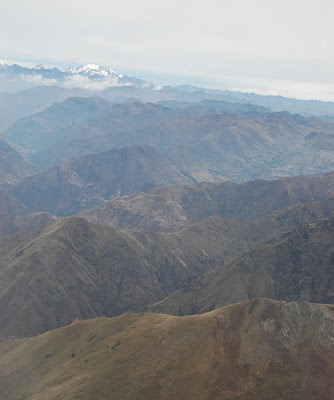
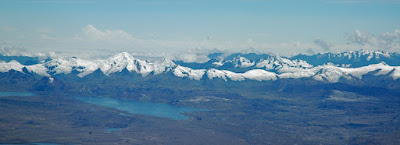
This morning we found our way to the train station to buy our train tickets for tomorrow morning's trip to Machu Picchu, which leaves Cusco at 6am. Just as with everything else, it went perfectly, no glitches. It's really kind of remarkable, like we've wandered into some paradisaical Twilight Zone (with the exception of our techno problems, of course). On every trip there are things that go wrong, plans that go awry, places that are much worse than we expected, hotels that are bad, something goes wrong. Instead, on this trip -- so far -- nothing has gone awry. In fact, we were watching the weather and it always said that it would be raining the whole time we're in Cusco, but it's been nothing but perfectly sunny clear weather. Cloudy in the morning, then sunny blue by 10am. Weird and wonderful. And the flights have been uneventful, too. No real delays, easy flights, very nice airplanes. Since most flights are 30 minutes long, there is no service; we climb, level off, then begin our descent. Quick quick. Presto. This is what it looked like as we started our descent into Cusco -- incredible geography:
So this is the first time on our vacation that Marc and I have gone separate ways for a bit. He's gone to the bank in the main square, which is an easy 10-minute walk downhill but a less easy walk uphill coming back. The street is a very narrow alley, with sidewalks on either side that are wide enough for one person only. And in places, it even disappears. Buses and taxis come hurtling down that alley, so it's always an "exciting" experience. While he's gone down to the square, I'm in the lobby catching up a bit.
 Let's see. Last night we ate dinner at this little tiny restaurant on a tiny street. The name was Relic, or something like that (note to self-look it up later). It was one small square room with a blue wall, a yellow wall, a black wall, and a huge video camera in the corner. And the tv was blaring, I mean really blaring Spanish tv, which means cacophanic. It was hot, they had strong incense burning, and we were the only people in the restaurant. Still, it was Sunday night and the big meal here is lunch, so finding a good place for dinner was a bit uncertain. Marc ordered stuffed trout, and I ordered a vegetable tortilla, which is like a frittata. There were two young women working there, so when we placed our order, one went in the back room and started chopping vegetables. The other went to the store to get the main ingredients. And like most every other restaurant in Peru, they brought our meals out separately -- often 10 or 15 minutes' difference. In this case it made sense, since the woman was cooking our dinners individually.
WELL. The dinner was out of this world. Marc is always wary about ordering fish in restaurants because it's usually overcooked, but even he was blown away. The flavors were so subtle, with such depth, and the fish was very fresh and cooked just perfectly. Even his rice, which is often kind of dry and an afterthought, was moist and lightly buttered. There was a shredded beet and carrot salad on the side. My tortilla was every bit as wonderful. A family of 3 came in after we ordered, so once we had our food the cook started on those meals. And, as before, the other woman ran out the front door to go buy the ingredients. They did this for every meal we observed. It may be the very best meal we've had so far.
Our hotel is incredible. Our bedroom opens onto a lovely terrace, and you walk up a flight of stairs into our bedroom. There's an elevated platform by the huge window overlooking the city, with a small table and chairs and a little fridge. So we lie in bed and watch the sun come up and go down over the mountains, and the city lights rise and fall. They're beautiful, too, yellow and blue.
 at night
 how perfect, that sliver of moon

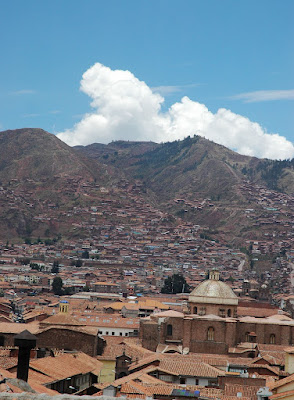
Of course, once we've walked up the hill from the plaza, then up the stairs to our terrace, then up the stairs to our bedroom, we're hot and panting and have to lie down.
 our terrace
 more of the view from our bedroom
The hotel is this little boutique hotel that used to be someone's home, and it's up the hill from the main plaza, in the artisans' section of town called San Blas. It's been the artisan quarter for centuries, apparently. A block away from the hotel is the San Blas Plaza, surrounded by little alleyways of shops. I'd been thinking I wouldn't buy anything here, because they're so focused on the tourists that all we've seen are garish tchotchkes. Bright red and pink and sky blue serapes, even more garish prints of Machu Picchu, etc. But in this artisan's quarter the shops carry handmade beautiful things. Onyx and silver earrings, lovely scarves, handmade suede purses. Presents to come for our three girls.
Cusco: The Movie!
The Cusco square is like all the others -- named Plaza des Armes, and flanked by churches. Other buildings have balconies on the 2nd floor, overlooking the plaza, made for people watching and coffee drinking.
 the Cusco Cathedral


 ancient Incan stone walls
 those blue balconies are often in coffeeshops; we had a favorite
coffee place, for espresso, cappucino, and pitchers of limonade
 I don't think this looks like me, but I really
like it -- I look as happy as I was
 and I love this photo of Marc
 old Cusco women and their llamas

 OK -- adios muchachas!


So this is the first time on our vacation that Marc and I have gone separate ways for a bit. He's gone to the bank in the main square, which is an easy 10-minute walk downhill but a less easy walk uphill coming back. The street is a very narrow alley, with sidewalks on either side that are wide enough for one person only. And in places, it even disappears. Buses and taxis come hurtling down that alley, so it's always an "exciting" experience. While he's gone down to the square, I'm in the lobby catching up a bit.
 Let's see. Last night we ate dinner at this little tiny restaurant on a tiny street. The name was Relic, or something like that (note to self-look it up later). It was one small square room with a blue wall, a yellow wall, a black wall, and a huge video camera in the corner. And the tv was blaring, I mean really blaring Spanish tv, which means cacophanic. It was hot, they had strong incense burning, and we were the only people in the restaurant. Still, it was Sunday night and the big meal here is lunch, so finding a good place for dinner was a bit uncertain. Marc ordered stuffed trout, and I ordered a vegetable tortilla, which is like a frittata. There were two young women working there, so when we placed our order, one went in the back room and started chopping vegetables. The other went to the store to get the main ingredients. And like most every other restaurant in Peru, they brought our meals out separately -- often 10 or 15 minutes' difference. In this case it made sense, since the woman was cooking our dinners individually.
WELL. The dinner was out of this world. Marc is always wary about ordering fish in restaurants because it's usually overcooked, but even he was blown away. The flavors were so subtle, with such depth, and the fish was very fresh and cooked just perfectly. Even his rice, which is often kind of dry and an afterthought, was moist and lightly buttered. There was a shredded beet and carrot salad on the side. My tortilla was every bit as wonderful. A family of 3 came in after we ordered, so once we had our food the cook started on those meals. And, as before, the other woman ran out the front door to go buy the ingredients. They did this for every meal we observed. It may be the very best meal we've had so far.
Our hotel is incredible. Our bedroom opens onto a lovely terrace, and you walk up a flight of stairs into our bedroom. There's an elevated platform by the huge window overlooking the city, with a small table and chairs and a little fridge. So we lie in bed and watch the sun come up and go down over the mountains, and the city lights rise and fall. They're beautiful, too, yellow and blue.
Cusco out our bedroom window
 at night
 how perfect, that sliver of moon

Of course, once we've walked up the hill from the plaza, then up the stairs to our terrace, then up the stairs to our bedroom, we're hot and panting and have to lie down.
hotel front door
 our terrace
 more of the view from our bedroom
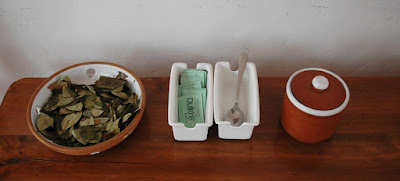
The hotel lobby is really charming. I sit here to write these posts and listen to Peruvian music (which isn't only pan pipes, of course). They have complimentary coffee and hot water for tea, which primarily means coca tea. And of course, there's the ubiquitous large bowl of coca leaves. On every table in our hotels, there is always a large bowl of coca leaves. When you check in to hotels, they bring you a cup of hot coca tea. I drank it a few times and it tasted like chamomile tea, and I felt no effect at all.

The hotel is this little boutique hotel that used to be someone's home, and it's up the hill from the main plaza, in the artisans' section of town called San Blas. It's been the artisan quarter for centuries, apparently. A block away from the hotel is the San Blas Plaza, surrounded by little alleyways of shops. I'd been thinking I wouldn't buy anything here, because they're so focused on the tourists that all we've seen are garish tchotchkes. Bright red and pink and sky blue serapes, even more garish prints of Machu Picchu, etc. But in this artisan's quarter the shops carry handmade beautiful things. Onyx and silver earrings, lovely scarves, handmade suede purses. Presents to come for our three girls.
The Cusco square is like all the others -- named Plaza des Armes, and flanked by churches. Other buildings have balconies on the 2nd floor, overlooking the plaza, made for people watching and coffee drinking.
 the Cusco Cathedral

 ancient Incan stone walls
 those blue balconies are often in coffeeshops; we had a favorite
coffee place, for espresso, cappucino, and pitchers of limonade
 I don't think this looks like me, but I really
like it -- I look as happy as I was
 and I love this photo of Marc
 old Cusco women and their llamas
 OK -- adios muchachas!
Subscribe to:
Posts (Atom)